
FULFILLMENT STRATEGY / 8 MIN READ
Custom Packaging MOQ: How Many Future Orders Are You Buying?
A lower price per box can require a larger commitment before the next order exists. Compare complete packing sets, usable quantities and the cash tied to a design.
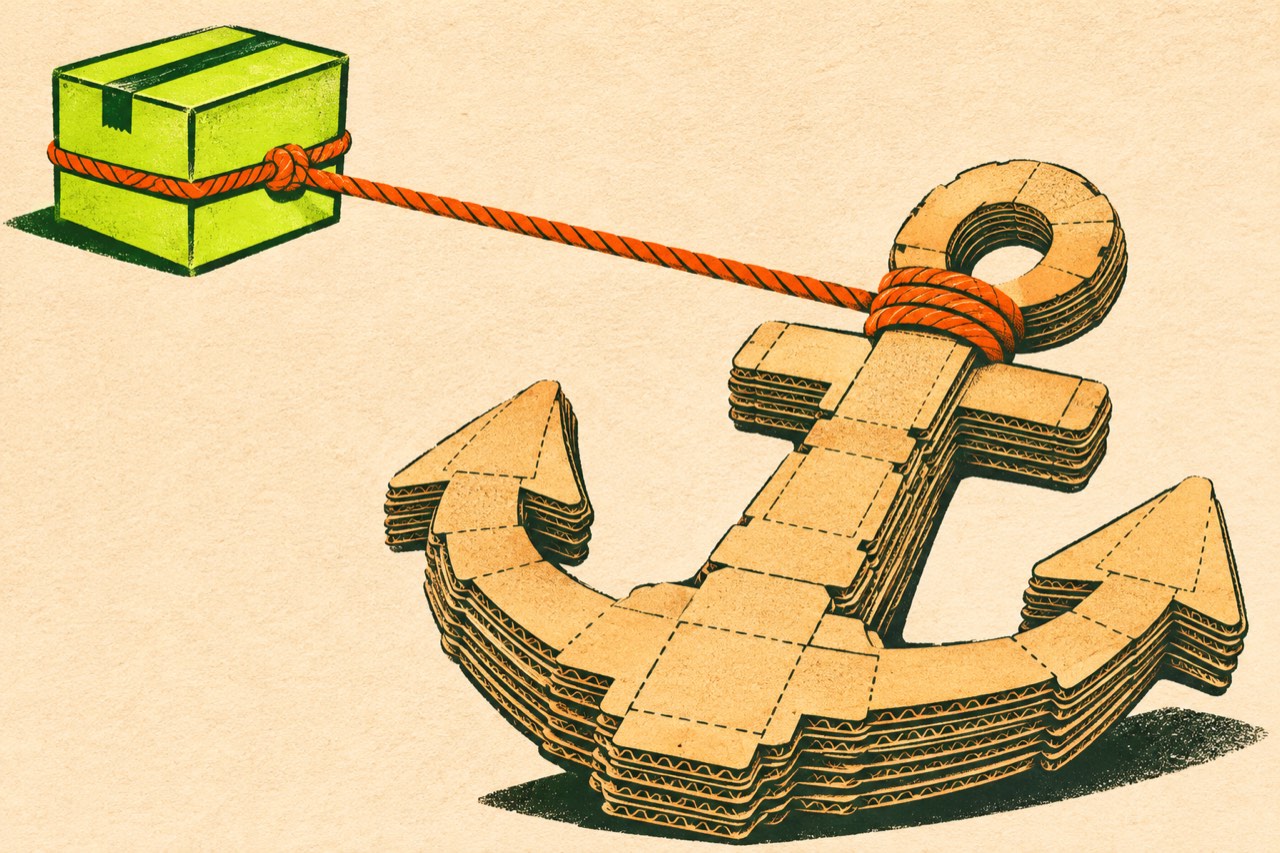
A packaging quote offers a lower unit price at a higher quantity. The artwork looks ready. The product is still being tested. Before approving the order, ask a different question: how many future shipments must use this exact packaging for the purchase to make sense?
Custom packaging MOQ, or minimum order quantity, is a purchasing condition. It does not establish customer demand, reserve finished products or tell a warehouse how to pack an order. For a dropshipping brand sourcing from China, those are separate decisions that need to meet before production begins.
We use packaging commitment horizon as an explanatory planning term: approved, usable packaging sets divided by the assumed rate of shipments that can actually use them. It is not an industry standard, a sales forecast or a supplier promise. Its purpose is to make an apparently small unit-price decision visible in time, stock and cash.
Ask for the MOQ of each component
A branded parcel may contain a shipping box, protective insert, sticker and printed card. They need not share a minimum quantity, production process or replenishment schedule. Ask for a component-by-component quote rather than a single sentence saying that custom packaging is available.
The difference can be substantial even within one supplier's catalog. When reviewed on November 6, 2026, Packlane's cardstock product-box page advertised a minimum of 25, while its separate custom-insert page stated 2,000 units. The product-box page was also marked out of stock. These are examples of product-specific published terms, not a statement of present availability, a recommendation to buy, an industry benchmark or DropFillShip's MOQ.
Count complete packing sets, too. In a hypothetical recipe requiring one box, two inserts and one sticker per parcel, 400 approved boxes, 800 approved inserts and 1,000 approved stickers support min(400, 800 ÷ 2, 1,000) = 400 parcels. The remaining 600 stickers cannot produce another finished set by themselves. If some components are held for inspection, remove those from the usable balance first.
Compare the same packaging job before comparing prices
Request alternatives that solve the same protection and presentation requirement. One option might use a standard outer package with a removable branded label. Another might use a short printed run, and another a fully customized structure with dedicated artwork. These are options to investigate, not a guarantee that a supplier offers all three.
For each option, specify material, board or film specification, dimensions, printing sides, finish, closures, protection and items per order. Separate one-time artwork or tooling charges from recurring material and packing charges. Ask who owns reusable tooling, how long it is retained and what a repeat order includes. Do not assume that a lower repeat print price eliminates setup or storage costs.
Match the full parcel, not just the box's appearance. DHL's packing guidance connects material selection to shipment size and weight, and emphasizes cushioning that prevents movement. A printed product carton is not automatically suitable as the shipping outer. For protection requirements, use the actual product and the selected carrier's applicable guidance; special products may need a separate assessment.
The DropFillShip packaging page sets out the brand details and packing instructions to discuss. Confirm the actual materials, minimums, costs and preparation time in a written quote.
Recalculate a cheaper box across 300 dispatched parcels
Consider two invented planning scenarios, both assumed to pass the same packing requirements. They are not supplier prices, customer results or expected savings. The comparison covers 300 eligible parcels dispatched in a 90-day review window. Dollar amounts are illustrative USD; product costs, carrier freight, taxes and duties are excluded and must be evaluated separately where applicable.
Option A: smaller purchase. Buy 300 packaging sets at $0.90: $270. Add $30 setup, $30 inbound delivery to the fulfillment location, $15 storage within the review window and $0.08 additional packing labor per dispatched parcel: $24. Total assumed outlay is 270 + 30 + 30 + 15 + 24 = $369, or $1.23 per dispatched parcel. All 300 sets are used under these assumptions.
Option B: larger purchase. Buy 1,000 sets at $0.45: $450. Add $100 setup, $50 inbound delivery, $45 storage within the same window and $0.05 additional packing labor on the 300 dispatched parcels: $15. Total assumed outlay is 450 + 100 + 50 + 45 + 15 = $660, or $2.20 per dispatched parcel in that window. There are 700 unused sets, representing 700 × $0.45 = $315 of the material purchase.
The $315 is not automatically a loss. It may support later shipments if the product, design and packaging remain suitable. It is nevertheless cash already committed to materials not used by the first 300 parcels. Future storage, replacement, transfer and disposal costs are outside this example and could change the eventual result.
A material-used view of Option B counts 300 × $0.45 = $135, then adds the $210 in stated setup, inbound, storage and labor costs: $345 ÷ 300 = $1.15. That view answers a different question from the $2.20 outlay view because it leaves $315 in unused material. Label both views; do not present the smaller number as the complete cash requirement. This is a planning calculation, not an accounting or tax valuation rule.
Turn quantity into a commitment horizon
If a usable set balance is 1,000 and assumed eligible demand is 120 parcels a week, coverage is 1,000 ÷ 120 ≈ 8.3 weeks. If only 60 parcels a week qualify for that design, coverage becomes about 16.7 weeks. Neither number predicts sales. Both show how strongly the decision depends on which orders can consume the stock.
Eligible demand excludes products that do not fit, orders needing different protection and markets requiring a different approved packaging version. Keep packaging sizes and language versions separate. A reusable generic design may cover several products only after fit, presentation and packing rules have been checked for each.
Ask whether the design will remain useful for that horizon. A seasonal message, discontinued bundle or product-size change may strand otherwise undamaged packaging. Delaying a permanent print decision, or moving changeable information onto a replaceable component, can preserve flexibility. Evaluate the extra assembly work and protection impact before adopting that approach.
Approve the packed sample and the version
Use a sequence of review gates: agreed specifications, artwork proof, physical sample where needed, packed-product assessment and warehouse release. A digital proof can check content and layout; it does not by itself demonstrate physical fit, transit protection or the appearance of every production unit.
Record the approved dimensions, materials, artwork revision and acceptance criteria. Check the actual SKU variants, protective components, closure and carrier-label area. Use testing appropriate to the product and route; an attractive mockup or a gentle shake is not a substitute for any required performance testing. For regulated or special-handling goods, resolve applicable packaging requirements before approving the commercial design.
Specify how production differences, damaged units and rejected quantities are handled. Agree who inspects, when stock becomes usable and what evidence is retained. This keeps an ordered quantity from silently turning into an assumed usable quantity. It also prevents an early visual sample from being treated as approval for a later revision.
Give the warehouse a recipe and a replenishment owner
Assign a packaging identifier and version, then map it to the relevant product variants and order conditions. The packing instruction should state component quantities, placement, permitted substitutions and the action when a required item is unavailable. Ask the fulfillment team whether an exception needs approval or should hold the order; do not leave the packer to infer that from the artwork.
Track incoming, usable, held and consumed components separately in the agreed operational record. A packaging balance and a finished-product balance serve different purposes. This is a process recommendation; it does not assume every warehouse platform automatically tracks packaging as inventory.
For replenishment, a simple hypothetical trigger is expected usage during lead time plus an explicit buffer. At 120 sets a week, four weeks from reorder approval to usable receipt and a 60-set buffer, that is 120 × 4 + 60 = 540 sets. Check existing purchase orders and net usable stock before placing another order. Actual demand, delivery uncertainty, space and cash constraints should determine the real rule; four weeks and 60 sets are not service commitments.
Copy this custom-packaging brief
Before requesting a quote, assemble:
- Product links, variants, dimensions, weight and relevant handling needs.
- Destination markets, platform and the order combinations that will use this packaging.
- Required components and the quantity of each component per parcel.
- Material and print requirements, artwork revision and changeable information.
- An approved sample or a clearly defined sample-approval process.
- MOQ and price breaks for each component, with setup and repeat-order terms separated.
- Inbound, storage, assembly and packing charges, plus what the quote excludes.
- Assumed eligible demand, a review window and lower-demand scenarios.
- Component ownership, inspection criteria, usable-stock release and version mapping.
- Replenishment owner, lead-time definition, substitutions and the plan for unused stock.
The operational question is: if demand is lower than planned, which packaging parts can still be used without changing the product promise? Answer it before approving a large run.
For the parcel-size side of the decision, our dimensional-weight guide explains why the complete packed dimensions matter. For a packaging discussion, send DropFillShip the product link, destination and brief. The next step is to confirm a workable specification and quote for your actual order pattern.